| Best Viewed On Phone In Landscape |
|
 |
Sign In |


In this NLP Neuro Semantic article, Michael Hall talks about Colleges and Universities— which should be places for true thinking, openness to ideas, willingness to hear out different viewpoints— have become one of the most constrictive places for true thinking. Conservative views are not only not allowed, but are politically unpopular, not “politically correct,” and those who hold them are treated as evil persons.. Phone 07 5562 5718 or send Abby an email to book a free 20 minute telephone or Skype session. NLP, Hypnotherapy and Medtation, Gold Coast, Robina.
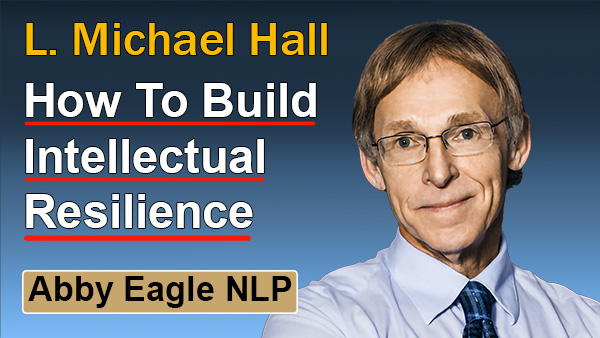
How fragile thinkers can build intellectual resilience using NLP
By L. Michael Hall, 2020 Neurons #32 June 29, 2020
Thinking for a Living series #18
"Some people are mentally and emotionally fragile when it comes to their ability to think— to entertain an idea, to try it on in their minds and then to question and explore it. After all, that is what true thinking is. The activity of actually thinking begins when you mentally consider a thought which is new and different. If you are just mentally repeating what you already know, you are not actually thinking, you are rehearsing known information. [You can find a detailed description of this in Executive Thinking.]
Yet for some people— those mentally and emotionally fragile, perhaps untrained, undisciplined, insecure— they cannot do that. When they encounter a new thought or one that differs with what they already know, they automatically disagree and reject it. As a mental reaction, this is not thinking, it is the opposite. It is non-thinking reactivity. And why? Precisely because it differs with what they currently understand, because they don’t understand it, and because it puts them out of their comfort zone —they feel insecure and anxious. As a fragile thinker, they need others to agree with them and to confirm them. And because they are fragile— inwardly weak and insecure, their basic ploy when someone contradicts them is to react, to act like a tantrum-throwing child, a fascist dictator who has to have things his way.
The very idea of entering into the intellectual arena where there can be a battle of ideas scares the hell out of them. They wouldn’t dare. And why not? Because of their worries, “What if I’m wrong?” “What if someone has a stronger argument?” “What would I do then?” What is behind or underneath this? Not only a basic insecurity, but a mis-use of information and knowledge. Instead of letting ideas battle things out as both sides of an issue are presented, argued for, and examined for the quality of thinking (reasoning) involved and then choosing the best ideas— people cling to ideas as making them okay. Instead of being okay as a human being who then plays with ideas, entertains ideas, tests ideas, etc., they misuse ideas. “My ideas make me okay as a person.” “Being politically correct validates me as a person.”
The fragile thinker is a victim of the Confirmation Bias— they cannot live in the intellectual environment where there are opposing ideas. If someone holds an idea, understanding, interpretation, or belief different from theirs, they take it as a personal affront. They then attack the person who dares to challenge them. Ironically, Colleges and Universities— which should be places for true thinking, openness to ideas, willingness to hear out different viewpoints— have become one of the most constrictive places for true thinking. Conservative views are not only not allowed, but are politically unpopular, not “politically correct,” and those who hold them are treated as evil persons.
That’s the non-thinking attitude of fragile thinkers. Because their thinking is not robust and cannot handle the battle of ideas, fragile thinkers fear differences and any conflict with their views. They whine like little children, “I’m uncomfortable when you say that.” Or they accuse the one who differs as offending them and demand that they be deprived of their freedom of speech. They avoid both differences and conflict as if holding a different view was inherently a bad or evil thing. They engage in a pseudo-solution by condemning the opposite side as demonic. They say there are not two sides to an issue, there’s only one side— the right side. Their side!
Of course this is what any dictator does. They refuse to allow others to have their say and persecute those who hold different views. Then, in an ironic reversal, they call those who differ and who simply want their voices heard —fascists.
What’s the solution? It is psychological. It is to ground one’s person as a human being in unconditional value. We call that self-esteem (not to be confused with self-confidence, or self-image, or self-belief, etc.). To esteem one self on any condition constructs conditional self-esteem which is the basis for any and all fragile thinkers.
The solution is to esteem yourself as a person unconditionally. It is to esteem your worth and value as a human being solely and simply on the fact that you are a human being and human beings are innately valuable, lovable, and of incredible potential. If you base your worth and value on your money, looks, strength, intelligence, racial heritage, religion, education, status, etc., you are setting yourself up for your self-esteem to go up and down according to your conditions. You will then take things personal when any of the conditions fluctuate.
To be a robust thinker who can “think for a living” and think in a clear, rational, and precise way— start with distinguishing your “person” from your “thoughts.” Thinking is something you do. It is not what you are. And your thinking, like every other aspect of you, is fallible. Regarding thinking, you are often wrong. Everyday you make mistakes in reasoning, remembering, imagining, thinking things through, deciding, evaluating, etc. A fragile thinker tries to avoid that reality. A robust thinker embraces this as the human condition. By embracing your cognitive distortions, biases, and fallacies, you can catch yourself in real-time and make adjustments. That will make you an excellent thinker and it will show up in the quality of your understandings, decisions, and choices." Author: __ Michael Hall
References: Executive Thinking (2018). Secrets of Personal Mastery (1997). https://www.neurosemantics.com/products/
Share With Friends





| The secret of high achievers |
|---|
 |
| How to build a powerful team |
 |
| Learn the NLP Meta Model |
 |
| How I stopped drinking alcohol. |
 |
| How to coach yourself using NLP. |
 |
Copyright © Abby Eagle