| Best Viewed On Phone In Landscape |
|
 |
Sign In |


The NLP Meta Model is a linguistic tool (critical thinking skills) that every parent, every child, every member of society needs to learn n order for consciousness and society to evolve in a more positive direction. NLP Coaching, Hypnotherapy and Meditation.. Send an email to book a free 20 minute telephone or Skype session with Abby Eagle.
Develop Critical Thinking & Fact Checking Skills Using the NLP Meta Model
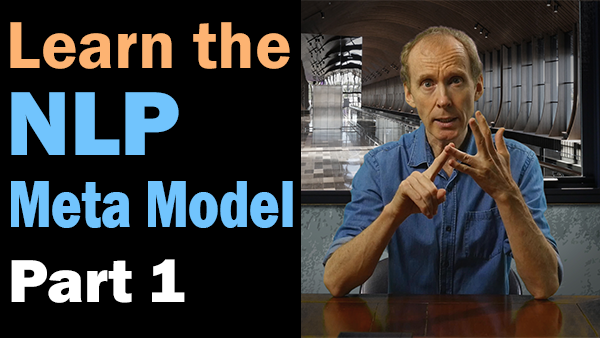
Click the Image to Watch on YouTube
The difference between a sheep and a wolf is that the sheep follows blindly while the wolf takes responsibility for their life. Learn to challenge everything for the truth using the NLP Meta Model. Challenge everything? Yes, everything!

What is the NLP Meta Model?
(Abby Eagle) The NLP Meta Model is a linguistic tool (critical thinking tool) that was developed by Richard Bandler and John Grinder, and first published in The Structure of Magic, Volume 1 in 1975. It was later updated by Michael Hall and published in Communication Magic in 1997. It gives you a set of questions to think critically and help you gather high quality information. Use it to find out what people actually mean by their communication not what you think they are saying. If you meta model your own thought processes then you can achieve more in life.
The Meta Model is based upon the notion that we don't operate on the world directly but take in information through our sense organs and using the three universal modelling processes of distortion, generalisation and deletion we form an internal representation (a map) in pictures, sounds, feelings, tastes and smells (VAKOG). The maps that we make in our minds are not the world itself but an internal representation of it. Alfred Korzybski, founder of General Semantics coined the phrase, “The map is not the territory”.
The NLP Meta Model has three categories.
1. Distortions
2. Generalisations
3. Deletions
1. Distortions
Distortion is the process which allows you to construct, manufacture, create and manipulate sensory data. Distortion is the process of bringing in information through your senses and then playing with that information in your mind to create new concepts, ideas and understandings. Different ways of thinking about the world, philosophy, spirituality, religion, ideology, fantasising about a lover, creating new inventions, writing fiction and producing films all rely upon the ability to distort so called reality. The ability to play with thoughts in your mind allows you to build goals of the future - a future that causes you pain or pleasure.
2. Generalisations
Generalisation is the process by which you take an element of your model of the world and use it to represent an entire category of experience. For example, a small child learns that things have 'handles' which enable them to be held, moved, opened and manipulated in some way. For example, a cup has a handle; a door has a handle; a key can be thought of as a handle; a bag has a handle; a knife and fork are handles which give you a tool to cut and hold. A tap is a handle to open and close water flow; an 'on off' switch is a handle; a remote control device for a television has a number of handles called 'buttons', and so on.
Generalisations can work for or against you. For example, having one bad experience with a member of one religion does not mean that all the people who share that religion are the same. In one context it may not be okay to use certain types of words but that does not necessarily mean that it is not okay in other contexts. Having one bad experience with a woman does not mean all women are the same, yet when people create these types of generalisations it may limit rather than enhance their lives.
3. Deletions
Deletion is the process of selective attention. Whether this be a conscious decision or an unconscious process it is clearly impossible to pay attention to the mass of information that impacts your senses. At some level of awareness you have to choose what to pay attention to. By choosing to focus in on some aspect of your sensory experience you naturally have to delete other information, for example. To hear someone in a crowded room you may have to concentrate in on the speaker and not listen to other conversations. Driving a car in heavy traffic you may need to focus on the road ahead to the detriment of the scenery that passes you by. In a garden you may choose to enjoy the fragrance of a rose yet ignore other sights, sounds, sensations and smells. At times deletion may be useful yet in other contexts it may result in an impoverished experience. For example, if you delete the nice things that people say to you and do for you, and instead focus on what they did not do or say then you may feel unloved.
NLP Meta Model Summary
The Meta Model formalises the process of distortion, generalisation and deletion into a set of linguistic patterns that give you a tool for mapping the structure of how someone is thinking by analysing the words that they use. Meta Model violations do not indicate that someone is thinking incorrectly, just that this way of thinking may work for or against them.
Typically the NLP Meta Model is used to question the words that people use so as to improve the quality of the conversation. But the Meta Model can also be used to analyse the structure of how someone thinks and then deliver information back to them in a form that matches their linguistic structures, as a means to influence that person to some desired outcome, whether that desired outcome be theirs or of the person who is talking to them.
The answer, "I don't know.", to a question indicates that the speaker has reached the limit of their model of the world.
The following version of the NLP Meta Model covers the original ten patterns. Michael Hall added nine new distinctions in 1997 in his book, Communication Magic. To make it easier to memorise the basic Meta Model use the acrostic: MLCCP UM NUS
A. DISTORTIONS
1. Mind Reading
2. Lost Performative
3. Cause and Effect
4. Complex Equivalence
5. PresuppositionsB. GENERALISATIONS
6. Universal Quantifiers
7. Modal OperatorsC. DELETIONS
8. Nominalisations
9. Unspecified Verbs
10. Simple Deletions
Watch the NLP Meta Model videos on youtube.
Click the Image to Watch on YouTube
NLP Meta Model Discussion
-----------------------------
DISTORTIONS
1. Mind Reading
A mind read is where you think that you know what someone else is thinking or feeling without any sensory based information to support that idea. Mind Reads can take a number of forms. One is where I think I know what you are thinking and feeling. Another is where I think that you should know how I think or feel. One can also hold mind reads about the future, as in crystal ball gazing and prophesying.
Gather more information about the mind read by asking, "How and what?", type questions.
Example Mind Read Statements
- "He does not like me."
- "You don't give me what I need."
- "I just know that I am going to win the Lottery."
- "I know that you will want to buy an Apple Mac."
- "You have no idea what you are getting in to."
Meta Model Challenge
- "How do you know that he does not like you?"
- "What do you need specifically?"
- "Really!? How specifically do you know that?"
- "How do you know that I want to buy an Apple Mac?"
- "How do you know that I have no idea of what I am getting into?"
Reply (Information recovered)
- "Well it is just that he does not return my phone calls."
- "I need to feel loved and secure."
- "It is just this feeling that I have." (You would need to ask more questions to discovery specifically how they represent the idea that they are going to win the lottery.)
- "Because you are using a PC."
- "Because..."
Use a Mind Read to Influence Another Person
- "You know that he likes you, don't you?"
- “You know that understanding language patterns is the key to influencing people?”
- “You know that you would jump at the opportunity to teach the Meta Model to school kids.”
- "You know that the Meta Model gives you the tools to challenge the priests, the politicians and the merchants with their deceptive rhetoric.”
2. Lost Performative
A lost performative is a value judgement which does not specify who is making the judgement of whether something is good or bad, right or wrong. It is where a person states their personal belief as a fact.
Challenge a lost performative to get the source of the belief, by asking, "Who says, according to whom, how do you know that?", type questions.
Example Lost Performative Statements
- "It's not good to eat all that fat."
- "You need to drink 2 litres of water every day".
- "Knowledge is power".
Meta Model Challenge
- "Who says that it's not good to eat all that fat? How do you know that to be true?"
- "Who says you need to drink 2 litres of water every day?"
- "According to whom?"
Reply (Information recovered)
- "It was on television."
- "Well my doctor said that I should do so".
- "Well I heard this seminar presenter say that it was".
Use a Lost Performative to Influence Another Person
- "It's great that you are going to the gym. You will feel so much better for it."
- "It is a good thing you got your hair cut. It will open up more job opportunities.
3. Cause and Effect
A cause and effect meta model violation is based upon the belief that 'A' causes 'B' when in fact there may be no factual evidence to support that belief. In the context of linguistics the cause is wrongly put outside of self. The belief is that something occurs in the world that makes you think or feel a certain way, or makes you do something. An event in the world 'A' causes you to feel, think or do 'B'.
But we are the meaning makers - that is no one can make you feel a certain way; no one can make you angry; no one can make you fat and no one can make you think a particular way or act in a particular way (putting aside the context of torture or indoctrination)
A cause and effect linguistic pattern is recognised by the use of words such as, "makes, because, if... then, as... then, since, so".
Gather more information about a cause and effect by asking, "How specifically?", and use counter example type questions to learn how the person does the process of making themselves feel and act in a particular way.
Example Cause and Effect Statements
- "You make me angry when you talk like that."
- "If the share prices drop then I will be disappointed."
- "Eating fat will make you fat."
- "If you exercise then you will lose weight."
- “Democracy caused the suicide bomber to blow himself up in a car in the city of Stockholm”.
Meta Model Challenge
- "How specifically does what I am doing make you angry? If I pulled a face would that make you laugh?"
- "How do you do the process of 'disappointing, yourself?"
- "What type of fats specifically? How much fat? Do you know anyone who can eat a lot of fat yet not put on weight?"
- "How do know that to be true? Are there other variables in weight management that are more important than exercise? Have you met anyone who exercised yet gained weight?"
- “How specifically did the nominalisation “democracy” cause the man to blow himself up? Here we also begin the process of finding out what the man means by “democracy” and how an abstraction can make you do something.
When you hear the word ‘then’ you could also treat it as a complex equivalence in that A=B. In that case the response could be, “Since when does a drop in share price mean that you should feel disappointed? What other response could you have?” Either way we are directing the speaker to take responsibility for their state of mind.
Use a Cause and Effect to Influence Another Person
- "Just thinking about the beach makes you want to get outside and exercise."
- "Studying these Meta Model examples makes you want to learn more about NLP."
- “Hearing the example of the Muslim man who said that democracy caused the suicide bomber to blow himself up makes you want to make posts on Facebook and educate people in the use of the Meta Model.”
4. Complex Equivalence
A complex equivalence is about the relationship between two thoughts, ideas, events or objects. Where meaning is attributed to an event. Something means something else, that is A=B. For example, a man is late for his dinner date. The woman says out loud with a disappointed tone of voice, "You are late." She thinks to herself, "He does not love me anymore." She then decides to go out with another man. When her partner asks her why, she says, "Well I thought that you did not want to be with me."
A complex equivalence can be recognised as two separate thoughts, statements, ideas or events that are connected in the way that A=B. What is missing is the linkage such as 'that means',' that just means', 'it must be that'. Once we have identified the complex equivalence we can challenge it to gather more information.
A complex equivalence is different to a cause and effect. "I hate it when you are late.", or, "You make me angry when you are late," is a cause and effect. "You being late means you don't love me is a complex equivalence." The complex equivalence is at a higher level of abstraction.
Challenge a complex equivalence to get the two statement that are linked, and/or to get a counter example. For example, "So does A have to equal B? Does it always have to mean that? Could it mean something else?"
Example Complex Equivalence Statements
- "You are late again. You don't love me."
- "Another asylum seeker boat sank in Australian waters. The Australian government is responsible."
- "The phone won't stop ringing. I have to answer it."
Meta Model Challenge
- "How does my being late mean that I don't love you?"
- "What else could the sinking boat mean?"
- "Since when did a ringing phone mean that you have to answer it?" What else could it mean?"
Reply (Information recovered)
- "I believe that when two people love each other that they phone ahead of time if they think they might be late."
- "It could mean that it was unseaworthy or over crowded."
- "Perhaps it means that I should think about hiring a receptionist?"
Use a Complex Equivalence to Influence Another Person
- "Learning how to use the Meta Model means that you will be able to torture your teachers at School."
- "Buying a desk diary will mean that you become a lot more efficient which means that you will make a lot more money which means that you will get to go on that holiday in January."
5. Presuppositions
A presupposition is the condition or element in a statement which has to be true in order for the sentence to make sense. But in doing so we may accept something that is either true or false. For example, "The cat sat on the mat.", presupposes that there is a cat and a mat but was there really a cat or a mat? Only further investigation will prove this to be true or not. For a detailed list of presuppositions read The Structure of Magic Appendix B, by Richard Bandler and John Grinder, 1975.
We challenge a presupposition to get specific details and learn the truth of the matter. For example, in the statement, "The cat sat on the mat.", the questioning method could be, "How do we know if that is even true? Is there actually a cat, is there a mat? Who made that statement? Is this person a reliable and honest witness? Which cat? When, where and how did the cat sit on the mat? Show me the evidence?"
Example Presuppositions Statements
- An advertisement that states, "We serve healthy low fat meals", presupposes that meals are served; that the meals are healthy according to someone's criteria and that low fat is healthful.
- An advertisement for "low fat yogurt" presupposes that yogurt being low in fat has health benefits for some target group, and that regular fat yogurt could be bad for others. The image on the container will also have its own presuppositions that support the text. The placement of the yogurt container in the health section of the supermarket will contextually state the presupposition that low fat yogurt is healthy for health conscious people.
- An advertisement in a health clinic, "Prevent your next heart attack.", presupposes that the reader has already experienced a heart attack and that they will have another unless they follow the instructions in the advertisement. Another medical advert read, "Prevent your next bone fracture."
- An advertisement in a spam email had the heading, "Can this ten second trick prevent your heart attack?"
- Consumer groups want to know which foods contain GM ingredients and which don't yet the Biotech industry has a problem with this. Monsanto's view on food labelling: "We oppose current initiatives to mandate labeling of ingredients developed from GM seeds in the absence of any demonstrated risks. Such mandatory labeling could imply that food products containing these ingredients are somehow inferior to their conventional or organic counterparts." (21/11/2013)
Meta Model Challenge
- Use any suitable meta model question to challenge each and every element in the statement, for example. "Healthy in what way? Healthy according to whom? What type of fat specifically? Are low fat meals healthy for everyone or just some people?
- Regarding the medical adverts you could challenge the people displaying the adverts and ask them who specifically the advert is targeted at, and if they really want to influence healthy people to experience a medical problem by making negative hypnotic suggestions?
- Regarding Monsanto do they care about the rights of the consumer or are they more interested in protecting their corporate image?
GENERALISATIONS
6. Universal Quantifiers
A universal quantifier is an absolute generalisation (universal generalisation) that excludes exceptions by stating that something is true for everything. You can recognise a universal quantifier by the words, "all, always, every, never, everyone, no one, no body, none".
Challenge the universal quantifier to get a counter example by repeating the key word back to the speaker and marking it out by using intonation, volume and a questioning tonality.
Example Universal Quantifiers Statements
- "It always rains on my day off."
- "Everyone says that about you."
- "No body likes me."
Meta Model Challenge
- "It always rains on your day off?"
- "Everyone says that about me?"
- "No body likes you?"
Reply (Information recovered)
- "Well it seems like that."
- "Well not everyone. Three people did."
- "Sometimes it feels like no body likes me but maybe I have been hanging out with the wrong people?"
Use a Universal Quantifier to Influence Another Person
- "If you take this supplement you will never get sick."
- "Everyone has to learn the Meta Model."
- "No one is better suited to teaching others how to use the Meta Model than you are."
7. Modal Operators
Modus operandi (MO) refers to one's typical method or style of moving through the world. A modal operator is a type of adverb that precedes a verb and indicates whether we act out of necessity or possibility - that is, because we have to do something or because we want to do something. Modal operators are related to the motivational styles of moving away-from what we don't want, and moving towards what we do want.
Whether you do what you have to or what you want to it will still fulfil some value - either an away-from value or a towards value, or both. The number of values the action fulfills and the relative importance of those values will influence the strength of the motivation. Modal operators also determine the boundaries of what is possible for us to achieve.
Modal operators can be chained to move us from necessity to possibility. For example, read the following series of statements and notice how it changes your frame of mind:
"I don't want to leave the house but I should do some exercise. I think I could go to the beach. I know I can go the beach. Yes, I want to go the beach. I am going to the beach. I will go to the beach."
Gather more information about a modal operator by asking, "What would happen if?" What would happen if you didn't? What stops you?" You can also ask lost performative type challenges by asking, According to whom?" In some cases repeat the word and mark it out using a questioning tonality.
7.a Modal Operators of Necessity. As in 'should, should not, must, must not, have to, need to, it is necessary'.
Example Modal Operator of Necessity Statements
- "I should socialise more."
- "I have to get to bed early because I have a plane to catch."
- "We need to get the roof fixed before the rainy season."
- "Heraclitus’ famous phrase that ‘you can’t step in the same river twice’ should be understood as the claim that..."
Meta Model Challenge
- "Should socialise more? Who says that you should socialise more? Is this something that you really want to do?"
- "Is there anything stopping you from getting to bed early?
- "What will happen if we don't?"
- We could ask politely, "How else could it be understood?" Or, "What other meaning could it have?" Or we could use a lost performative challenge and ask, "Who says? According to whom?"
Reply (Information recovered)
- "Well they say that success is contingent upon the people you know and I think that I just need to spend more time networking."
- "You! Wasting my time, asking me these stupid meta model questions."
- "The next time we have heavy rain the tiles are going to leak; the water is going to bore a hole in the ceiling and it could destroy my electronic equipment."
Use a Modal Operator of Necessity to Influence Another Person
- "It is time that you took more care of your health. You should visit a naturopath and get some help. If you don't you could find yourself in the situation where you have to take time off work, and then you could lose your job."
7.b Modal Operators of Possibility. As in 'can, can not, will, will not, would, may, may not, it is possible, it is impossible'.
"Can not", is interesting because the speaker is saying they, "Can do the process of 'not'... (Richard Bandler). In the first example below the speaker says literally that they can not see. That is, they can not make an image of themselves interviewing Tony Abbot. The solution is to help them build the image.
Example Modal Operators of Possibility Statements
- "I can't see myself interviewing Tony Abbot."
- "It may not be possible for me to get to Thailand in January."
- "I think my business is at the stage where I can collaborate with others."
Meta Model Challenge
- "What stops you from seeing yourself interviewing Tony Abbot? What would that picture look like, sound like and feel like?"
- "What is stopping you?"
- "What would you like to achieve by collaborating with those people?"
Reply (Information recovered)
- "I don't think he would have the time to speak with an interviewer like myself but if he did then his secretary would escort me and my film crew into his office. There would be two cameras, one on him and one on me. We would need to be quick so we would need a guy holding a mic on a boom pole."
- "Two things. I need to complete this project that I am working on as it is taking a lot longer than anticipated. And my health is not so good at the moment. I am making improvements but I will need to wait and see what happens."
- "It would mean that I can rewrite my job description and get to focus on the projects that I really enjoy."
Use a Modal Operator of Possibility to Influence Another Person
- "At the moment you probably can't see yourself hiring a film crew but as you think about that right now you might begin to consider the first action steps that could make that project a possibility?"
Click the Image to Watch on YouTube
DELETIONS
8. Nominalisations
Nominalisations are process words (verbs) which have been frozen in time to make them a static thing (nouns). For example in the sentence, the investigation failed to find any evidence to support the claims. The noun investigation is derived from the verb to investigate. Verbs suggest a movement whereas nouns just 'sit there'.
The Greek Philosopher Heraclitus (544 BC), is quoted as saying that, "No man ever steps in the same river twice, for it's not the same river and he's not the same man." But when you think about it, how can you even step in the same river once, for the simple reason that a river (noun) is actually in a process of rivering (verb). Using the same line of thinking, a tree is actually a 'treeing'. Even a road is in process, and given time will decay. Most nearly everything in existence is in a process. People are born, they live and they die. Each moment brings new experiences and new memories, and every time that you think back on the past your memory of it changes in some way. Likewise the future is not caste in stone - the possibilities are ever changing. Life should be lived like a fresh breeze, constantly in a state of flux, ever moving and ever refreshing itself. Nominalisations on the other hand may cause a state of stagnation.
For example, in the film, The Stoning of Soraya M. we hear that "Justice demands that the woman be put to death". "Justice", is a nominalisation. Can you touch justice? Can you kick it, can you hold it, can you put it on a table? How can you challenge justice? You can challenge the people who are enforcing their version of justice but you can't challenge justice.
President George Bush declared a "War on terror" but how can you fight with a nominalisation? You can fight with specific people who engage in activities that terrify other people but how do you fight with terror? By not clearly defining 'terror' the government can do what ever it likes in the name of fighting terror.
Some people make statements like, "The scripture says...", or, "This is the word of God." But both scripture and God are nominalisations. What is a scripture and who is God?
To induce trance we use nominalisations and to bring people out of trance we ask questions that uncover the process. Believe it or not the most influential politicians and priests are masters of hypnotism, and that is whether they acknowledge it or not!
To denominalise a nominalisation ask questions that uncover the process like, "How specifically? How do you do the process of 'x'? What do you mean by that word?"
Example Nominalisations Statements
- "Justice demands that the woman be stoned to death."
- "We are winning the war on terror."
- "The scripture says that you must do x, y and z."
- "This is the word of God."
Meta Model Challenge
- "What is just about a system that allows men to brutally murder women?"
- “What do you specifically mean by terror? Can you show me terror because I would like to take a good look at it?” We could also ask, "What terrorful people, actions and events specifically are you warring against?"
- "What specifically is a scripture?"
- “What specifically do you mean by ‘the word’? What specifically do you mean by 'God'?"
Reply (Information recovered)
- "These are the rules that guide our thoughts and actions given to us by 'x' hundreds of years ago. We are just following the tradition."
- "The people who bombed the embassy."
- "The scripture is a compilation of stories about the life of a man." We might reply, “So you want me to do what some guy told his followers to do hundreds of years ago just because it is written in a book?”
- "Well first you have to form a belief in God, then slowly he comes to life for you." We might reply, "So God is a belief?"
Use a Nominalisation to Influence Another Person
- "Share the love". (This statement is used by a number of advertisers.)
- "You can buy this product with confidence because you are protected by our cancellation policy".
- "Now is the time for the government to implement policies that invite greater cooperation between corporations and government such that consumers can benefit from globalisation".
- "The Meta Model will transform the world".
9. Unspecified Verbs
Unspecified verbs are process words which don't specify to a greater or lesser degree what specifically is being referred to. Something is omitted. Gather more information by asking, "How specifically?", type questions.
Example Unspecified Verbs Statements
- "I have been trying hard to make more money."
- "That noise is getting on my nerves."
- "You can trust me because I am a doctor."
- “God is love”.
Meta Model Challenge
- "How specifically have you been trying?"
- "How specifically is that noise getting on your nerves?"
- "Trust you? In what way do you expect me to trust you? Based upon what?"
- “How specifically is God love? We are saying, “What is in that gap between the word god and the word love?
Reply (Information recovered)
- "I wrote up a business plan and then I created an action plan, and since then I have systematically been working through that plan."
- "It is the way the beat of the music seems to get my attention for a period of time and then it goes silent, and then as soon as I have relaxed the beat starts again."
- "I need you to comply with my directions because I don't have time to answer these type of questions and see 80 patients every day."
Use an Unspecified Verb to Influence Another Person
- "These solar panels will reduce your electricity bill."
- "Both our businesses will benefit if we collaborate on this project."
- "Close your eyes and relax the muscles around the eyes. Then take the relaxation from around the eyes and put it into your mind and relax all the thoughts from your mind."
- “Popularising the Meta Model is one way to help bring peace to the world”.
10. Simple Deletions
10.a Simple Deletions
There is a deletion when we sense that some information is missing from the statement. The way to check is by attempting to build a clear representation in the cinema of your mind? Start by asking yourself, "What is missing from this statement?", then ask questions like, "About what? About whom? What do you mean by that? What specifically?"
Example Simple Deletions Statements
- "I am not comfortable with this."
- "That guy is an idiot."
- "You just don't understand."
- "We are getting closer."
Meta Model Challenge
- "Not comfortable about what?"
- "What do you mean by idiot?"
- "What specifically don't I understand?"
- "Closer to where?"
Reply (Information recovered)
- "About giving the waiter my credit card."
- "He jumped from the rooftop of one building to a window ledge on the other side of the street, and then realised that he was fifteen feet above the ground." (An actual case in England.)
- "That some people are motivated by the thrill of jumping into the unknown."
- "Closer to our goal target of 100,000 unique visitors every month to the website."
Use a Simple Deletion to Influence Another Person
- "This is so awesome. You are so cool. You have what it takes. I think we should do it."
- "This product will give you just what you need."
- "That's great! You are getting there."
10.b Unspecified Referential Index
An unspecified referential index is where the phrase fails to specify a person or thing. For example, words like, "It, she, he, they, we, us, you, one, someone.", and generalisations which refer to a group like, "Australians, the British, the man in the street, people, Christians, politicians, journalists". Gather more information by asking, "Who, what or which specifically?"
Example Lack of Referential Index Statements
- "They say that you need to drink two litres of water every day."
- "It is not going to happen."
- "Politicians just can't be trusted."
Meta Model Challenge
- "Who says that you need to drink two litres of water every day?"
- "What specifically is not going to happen?"
- "Which politicians can't be trusted?"
Reply (Information recovered)
- "I heard it from my taxi driver."
- "Me coming to Hong Kong in October."
- "It seems like most politicians say one thing before the election then do something totally different once they get elected.
Use a Lack of Referential Index to Influence Another Person
- "Your customers will love this new product."
- "And as they say back in my homeland, as soon as you taste sashimi you will just want to eat some everyday."
- "You will love it."
- "People will come out in droves to watch this concert."
- "Women love this perfume."
- "It is going to work”.
10.c Comparative Deletions
A comparative deletion is where there is a comparison involving a greater or lesser value in which what is being compared is not specified. As in words ending in 'er' and 'est'. "Better, best, less, least, worst, more, bigger, lighter, smaller, very, even."
Recover the comparative deletion by asking questions like, "Better than who or what specifically? Compared to whom or what specifically?"
Example Comparative Deletions Statements
- "You can do better than that."
- "It is going to be lot easier visiting Thailand."
- "It would be the least that they can do."
Meta Model Challenge
- "Can do better than what specifically?"
- "Visiting Thailand is going to be easier compared to what place or activity specifically?"
- "What specifically are you referring to?"
Reply (Information recovered)
- "Better than $2,000.00 per week."
- "It is going to easier than sitting in my office writing these articles."
- "Putting a stop sign at that road intersection."
Use a Comparative Deletion to Influence Another Person
- "The more that you learn the meta model, the more that you will find yourself wanting to practise it, and the more that you practise the meta model the better you will get on with your parents, your friends and your teachers."
- "Even though this car has a smaller engine it has a lighter body which means the power to weight ratio is the best in this class of vehicle."
Bibliography
- Bandler, R., Grinder, J., Structure of Magic 1, Science and Behaviour Books, Palo Alto, California, 1975.
- Cameron-Bandler, L,. Solutions: Practical and Effective Antidotes for Sexual and Relationship Problems. San Rafael, California: Future Pace, 1985.
- L. Michael Hall, Ph. D. Communication Magic: Exploring the structure and meaning of language. Crown House Publishing, 2001.
___ © Author Abby Eagle
Share With Friends

| The secret of high achievers |
|---|
 |
| How to build a powerful team |
 |
| Learn the NLP Meta Model |
 |
| How I stopped drinking alcohol. |
 |
| How to coach yourself using NLP. |
 |
| Stop making excuses. No "buts" about it. |
 |
| Learn NLP rapport skills |
 |
| The power of acknowledgement |
 |




Copyright © Abby Eagle